
How Mental Maths Helps Children Solve Problems Faster
A child who can quickly see that 48 is close to 50 has a head start. Instead of counting in ones, they can adjust, estimate, check, and move through the problem with confidence. That is the real value of mental maths.
Mental maths is often mistaken for doing sums in the head as quickly as possible. Speed matters, but it is only part of the picture. Strong mental maths helps children recognise patterns, choose efficient strategies, hold numbers in working memory, and spot mistakes before they become habits.
For children in primary school, this can make a clear difference. Maths stops feeling like a page full of isolated sums. It becomes a set of tools they can use in class, at home, in shops, in games, and later, in more advanced subjects.

Mental maths builds number sense first
Fast problem-solving starts with number sense. This means a child understands what numbers mean, how they relate, and how they can be moved around.
A child with weak number sense may see `19 + 6` and count up one step at a time. A child with stronger number sense may think:
19 is 1 away from 20
Take 1 from 6 to make 20
Add the remaining 5
The answer is 25
Both children can reach the same answer, but the second child uses a strategy. That strategy is faster, lighter on memory, and easier to check.
Number sense includes skills such as:
recognising number bonds to 10, 20, and 100
understanding place value
splitting numbers into useful parts
estimating before calculating
seeing patterns in times tables
knowing when an answer looks reasonable
These skills matter because maths problems rarely arrive in neat textbook form outside school. A child might need to work out change from £10, share snacks fairly, read a bus timetable, or compare prices. Mental maths gives them a way to respond quickly without feeling stuck.
It reduces the load on working memory
Working memory is the mental space children use to hold and work with information. In maths, it gets busy very quickly.
Take a simple word problem:
Maya has 24 stickers. She gives 7 to a friend and buys 12 more. How many does she have now?
A child needs to remember the story, decide which operations to use, keep track of the numbers, and calculate correctly. If every calculation requires slow counting, the child may forget the problem before they finish solving it.
Mental maths helps by making common steps automatic. If a child knows that `24 - 7 = 17`, or can work it out quickly by thinking `24 - 4 = 20` and `20 - 3 = 17`, they free up space to focus on the meaning of the question.
This is why mental maths is not separate from problem-solving. It supports it. The faster and more confidently a child handles the number work, the more attention they can give to reasoning.
Children learn to choose smart strategies
Mental maths is not one method. It is a toolkit. The goal is not to teach children to do every sum in the same way. The goal is to help them choose the method that fits the numbers.
For example, consider `39 + 28`.
One child may use column addition. That works, but it may not be the quickest mental route. Another child may think:
39 is 1 less than 40
40 + 28 = 68
Take 1 away
The answer is 67
For `25 × 4`, a child does not need a long method. They can know that four 25s make 100.
For `18 × 5`, they might think half of `18 × 10`, which is 90.
For `96 + 37`, they may add 4 to reach 100, then add 33, giving 133.
These strategies help children move from counting to calculating. They also learn that numbers are flexible. A sum can be rearranged, split, rounded, doubled, halved, or checked in more than one way.

Visual methods make abstract numbers easier
Many children learn best when they can see or touch what they are doing. This is where abacus work, counters, number lines, and fingers can help.
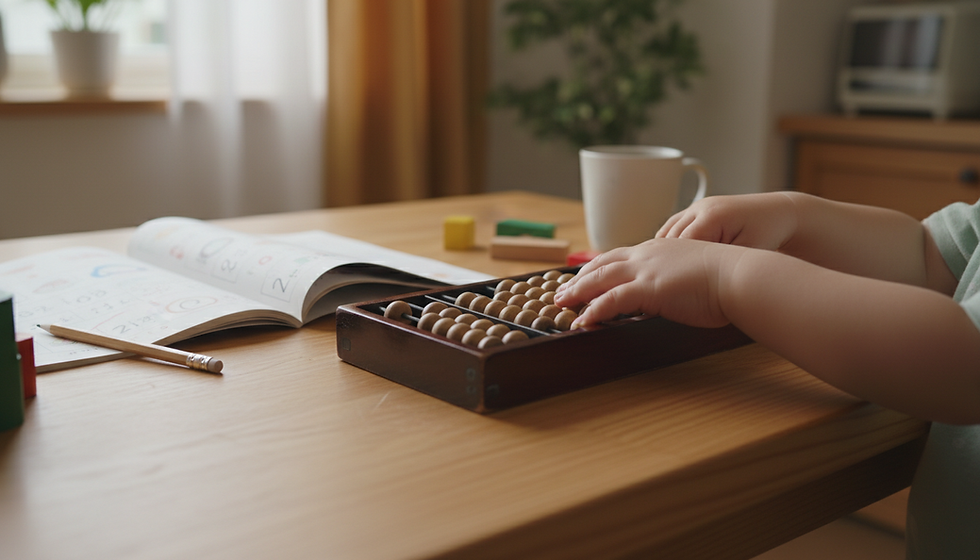
An abacus gives children a physical model of place value. Beads stand for ones, tens, hundreds, and so on. When children move beads, they can see how numbers build and change. Over time, they begin to picture the abacus in their mind. That mental image can help them calculate without the physical tool.
Finger methods can also support early learning when used well. Young children naturally use fingers because fingers are always available and easy to understand. The key is to help them move beyond counting one by one. For example, fingers can help children recognise five as a group, understand doubles, and see combinations that make 10.
Parents searching for abacus mental maths, finger maths, online abacus classes near me are often looking for the same thing: a practical way to help children become quicker and more confident with numbers. The best approach is one that connects visual understanding with mental strategies, rather than asking children to memorise steps they do not understand.
Speed grows from accuracy and confidence
Speed should not be rushed. If children feel pressured to answer quickly before they understand, they may guess, panic, or decide they are “bad at maths”.
Good mental maths develops in stages:
Understand the concept
Children need to know what addition, subtraction, multiplication, and division mean before they can use shortcuts well.
Practise with support
Visual tools, number lines, and spoken strategies help children make sense of the method.
Repeat until patterns become familiar
Short, regular practice works better than long sessions that feel tiring.
Apply the skill in mixed problems
Children need to decide which strategy to use, not just follow the last method they were shown.
Build speed naturally
Once a method feels familiar, children usually become quicker without being pushed.
This balance matters. Accuracy gives children trust in their own thinking. Confidence helps them take risks. Speed then becomes a result of understanding, not a race.

Mental maths improves real problem-solving
Problem-solving is more than finding the answer. Children have to read the question, understand what is being asked, choose a plan, carry it out, and check the result.
Mental maths helps at each stage.
When children are fluent with numbers, they can estimate before they calculate. If a question asks for `198 + 203`, they can see the answer should be close to 400. If they calculate 4,001, they know something has gone wrong.
They can also compare options faster. In a shop, a child might see two offers:
3 apples for £1.20
5 apples for £2.25
Each apple costs 40p
Each apple costs 45p
A child with strong mental maths can divide, compare, and make a decision without needing a written method for every step.
Mental maths also supports multi-step problems. For example:
A class has 28 pupils. Each pupil needs 3 pencils. The teacher already has 50 pencils. How many more are needed?
A child may think:
28 × 3 is 84
84 pencils are needed
84 - 50 is 34
The teacher needs 34 more pencils
If `28 × 3` takes too much effort, the rest of the problem becomes harder. If that part feels manageable, the child can focus on the structure of the question.
It helps children spot mistakes earlier
Children often make errors because they lose track of place value, misread signs, or accept an answer that cannot be right. Mental maths gives them checking habits.
For example, if a child works out `52 - 19` and gets 43, a quick estimate can catch the error. Since 19 is close to 20, `52 - 19` should be close to 32, not 43.
Useful checking habits include:
rounding numbers to estimate
using the opposite operation
checking whether the answer is bigger or smaller than the starting number
comparing with a known fact
asking if the answer makes sense in the story
These habits build mathematical independence. Children stop relying only on adults or answer sheets. They learn to question their own work in a healthy way.
Short daily practice works best
Mental maths improves through regular use. It does not need to take over the evening or become another source of stress.
A few minutes a day can be enough when the practice is focused. Good activities include:
counting forwards and backwards in 2s, 5s, 10s, and later 3s, 4s, and 6s
asking quick number bond questions during a walk
doubling and halving numbers while cooking
estimating the total cost of items in a basket
playing dice and card games that involve adding or comparing numbers
using an abacus to show tens and ones
practising times tables in short bursts
The best practice feels active. Instead of only asking, “What is the answer?”, try asking, “How did you know?” or “Can you find another way?”
That one question tells a child that the thinking matters as much as the result.
What makes a good mental maths class
A strong class should teach methods clearly, give children time to practise, and link speed with understanding. It should not rely only on timed tests or memorisation.
Good Mental Maths classes for Kids usually include:
clear teaching of number patterns
visual tools such as an abacus, counters, or drawings
step-by-step strategy practice
chances to explain thinking aloud
mixed questions that build flexibility
positive correction when mistakes happen
gradual speed-building once accuracy is secure
For younger children, lessons should feel concrete and active. For older children, mental maths should connect with fractions, decimals, percentages, measurements, and word problems. This helps them see mental calculation as a useful skill, not just a school exercise.
Frequently Asked Questions
What age should children start mental maths?
Children can start simple mental maths in the early years through counting, matching, comparing, and number bonds. Formal strategies usually build during primary school as children learn place value and basic operations.
Is mental maths better than written methods?
Both are useful. Mental maths helps children calculate quickly and understand numbers. Written methods help with larger or more complex calculations. Children need both so they can choose the best tool for the problem.
Can an abacus really help with mental maths?
Yes, when used properly. An abacus gives children a clear visual model of number and place value. With practice, many children start to picture the bead movements mentally, which supports faster calculation.
What if my child is slow at maths?
Slow does not mean unable. Some children need more time to build number sense and confidence. Short, calm, regular practice often works better than pressure or long worksheets.
How can parents support mental maths at home?
Use everyday moments. Ask your child to estimate totals, count change, double a recipe, compare prices, or explain how they worked something out. Keep it short and positive.

A faster answer starts with clearer thinking
Mental maths helps children solve problems faster because it improves the way they think about numbers. They learn to spot patterns, break problems into smaller parts, estimate, check, and choose efficient strategies. Also Read our Blogs on:
Are Online Abacus Classes Better Than In-Person Tuition? 5 Reasons Every Child Should Learn Abacus and Mental Maths How Mental Maths in UK Builds Confidence in Young Learners
The real aim is not speed for its own sake. It is confidence, flexibility, and control. When children understand numbers well, faster answers follow naturally.
For a structured way to build these skills, explore abacus mental maths for kids.


Comments