
The Maths Skill Parents Often Overlook: Speed + Accuracy
A child can understand a maths idea and still struggle to use it quickly and correctly. That gap can be frustrating. They know what to do, but the answer feels just out of reach. They count on fingers for every sum, lose track halfway through a calculation, or rush and make small mistakes.
Speed and accuracy in maths often sit in the background. They are less obvious than learning a new topic, such as fractions or long multiplication, but they support almost everything children do in school maths. When basic facts feel secure, children have more space to think, reason, explain and solve problems.
The aim is not to turn maths into a race. Confident learners need both pace and care. They need to recall key facts without panic, check their work sensibly, and know when to slow down. With the right routines, games and encouragement, families can help children build this skill without adding pressure.

Why speed and accuracy matter more than they first appear
Speed in maths means being able to recall or work out facts efficiently. Accuracy means getting answers right and noticing when something does not make sense. Each one helps the other.
A child who knows that 7 × 8 is 56 can focus on the bigger problem in front of them. They do not have to spend all their mental energy rebuilding that fact from scratch. This matters in topics such as:
Fractions, where children need multiplication and division facts
Written methods, where place value and number bonds must stay secure
Word problems, where they need to understand the situation as well as calculate
Measures and money, where quick estimates prevent silly errors
Algebra later on, where basic arithmetic should feel automatic
This is why speed and accuracy are part of overall mathematical proficiency. They free up working memory. That is the mental space children use to hold information, follow steps and spot patterns.
Think of reading. A child who has to sound out every single word may understand the story, but reading feels hard work. Once word recognition becomes fluent, they can enjoy the meaning. Maths works in a similar way. When number facts become familiar, children can pay attention to reasoning.
There is also an emotional side. Children who take a long time over every calculation may start to believe they are “bad at maths”. Children who rush and make mistakes may lose marks even when they understand the method. Building this maths skill helps children feel steadier.
That said, faster is not always better. A child who answers quickly but guesses is not fluent. A child who works carefully but has no recall may struggle as maths becomes more demanding. The goal is a balance: accurate first, then gradually quicker.
How parents can build speed without creating pressure
Children improve when practice is regular, short and focused. Long worksheets are rarely the best choice, especially after a full school day. A few minutes of well-chosen practice can be far more useful.
Start with accuracy before timing
Before using a timer, make sure the child understands what they are doing. If they are practising number bonds to 10, they should be able to show them with objects, draw them, or explain them aloud.
For example:
6 and 4 make 10
7 and 3 make 10
8 and 2 make 10
Once they can answer correctly most of the time, add gentle pace. Ask, “Can you do these five before I finish making your drink?” rather than “You only have one minute.” The tone matters.
A timer can be useful for some children, but stressful for others. If it causes panic, use a softer challenge:
Beat your own score from yesterday
See how many you can answer correctly in a short song
Try five questions with no timer, then five with a timer
Sort facts into “quick”, “nearly there” and “needs practice”
Practise little and often
Maths fluency grows through repetition over time. Five minutes most days is usually better than a long session once a week.
Good moments include:
On the walk to school
In the car or on the bus
While laying the table
During bath time for younger children
Before screen time
While cooking or shopping
Keep it light. Ask two or three questions, then stop. Children are more likely to join in tomorrow if today felt manageable.
Use strategies, not just memorisation
Speed does not mean children must memorise everything in isolation. Good mental strategies help them work quickly and accurately.
Useful strategies include:
Strategy | Example | Why it helps |
Make 10 | 8 + 5 becomes 8 + 2 + 3 | Builds strong number bonds |
Double and adjust | 6 + 7 becomes 6 + 6 + 1 | Uses known doubles |
Use friendly numbers | 19 + 6 becomes 20 + 5 | Reduces mental load |
Break apart numbers | 34 + 25 becomes 30 + 20 and 4 + 5 | Supports place value |
Use inverse facts | If 9 × 4 = 36, then 36 ÷ 4 = 9 | Links multiplication and division |
Ask children how they got an answer. If their method works, celebrate it. If it is slow or likely to cause errors, show a simpler path.
Make mistakes useful
Errors are not a sign that practice has failed. They show what needs attention. The key is to respond calmly.
Try saying:
“Let’s find where it changed.”
“Does that answer feel too big, too small, or about right?”
“Which step was tricky?”
“Can we check it another way?”
Encourage children to estimate before calculating. If they work out 49 + 52 and get 811, an estimate of “about 100” helps them spot the problem. Estimation is one of the best tools for accuracy.
What to practise at each stage of primary school
Children develop at different rates, so these stages are a guide rather than a strict checklist. If a child is older but shaky on earlier skills, revisiting them is sensible. Strong foundations make later work easier.
Early years and Key Stage 1
At this stage, children need to develop number sense. They should see numbers as amounts, not just symbols.
Focus on:
Counting forwards and backwards
Recognising numbers to 10, then 20 and beyond
Number bonds to 5, 10 and 20
Doubles, such as 4 + 4 and 6 + 6
One more and one less
Simple addition and subtraction stories
Use objects often. Coins, pasta, buttons, toy cars and building bricks all work well. Ask questions such as, “We have 6 grapes and eat 2. How many are left?” Real objects reduce guesswork and build meaning.
Lower Key Stage 2
This is when times tables become a major focus. In England, children take the Multiplication Tables Check in Year 4, so quick recall is helpful. More importantly, tables support many later topics.
Focus on:
2, 5 and 10 times tables
3, 4 and 8 times tables
Related division facts
Number bonds to 100
Adding and subtracting two-digit numbers mentally
Place value to 1,000 and beyond
Practise tables in mixed order, not only chanting from the start. A child may know “2, 4, 6, 8” but still pause when asked 4 × 2. Mix the questions once the pattern is familiar.
Upper Key Stage 2
Older primary children need fluency across all four operations. They also need to choose sensible methods.
Focus on:
All times tables up to 12 × 12
Multiplying and dividing by 10, 100 and 1,000
Equivalent fractions, decimals and percentages
Mental addition and subtraction with larger numbers
Checking written calculations
Estimating answers before solving
At this age, accuracy often improves when children slow down at key points. Teach them to reread the question, line up digits carefully, and check units in measure or money problems.
Fun activities that improve maths skill- speed and accuracy
Practice works best when children feel involved. Games add repetition without making it feel like a test.
Play quick number games with cards and dice
A normal pack of cards can become a maths kit. Remove the picture cards if needed, or give them values later.
Try these games:
Turn over two cards and add them.
Turn over two cards and multiply them.
Make 10 using any cards in your hand.
Choose three cards and build the largest number.
Roll two dice and race to say the total.
Roll two dice and find the difference.
For older children, use three dice. They can add all three, multiply two and add the third, or create a target number in different ways.
Turn everyday routines into maths practice
Real life gives children a reason to calculate.
In the kitchen, ask:
“We need 200 g of flour, but we have measured 150 g. How much more?”
“If this recipe serves 4, what would we need for 8?”
“The pasta cooks for 12 minutes. What time will it be ready?”
When shopping, ask:
“This costs £1.80 and that costs £2.20. What is the total?”
“If we pay with £5, how much change?”
“Which is cheaper per item?”
Keep questions short. The aim is to build confidence, not turn every outing into a lesson.
Use movement for active learners
Some children think better when they move. Use physical games to practise facts.
Ideas include:
Skip count while bouncing a ball
Jump on number cards laid out on the floor
Clap times table patterns
Throw a beanbag onto the correct answer
Do a “maths treasure hunt” around the room
Movement can help children who find sitting still difficult. It also makes repetition feel less dull.

Try visual and hands-on resources
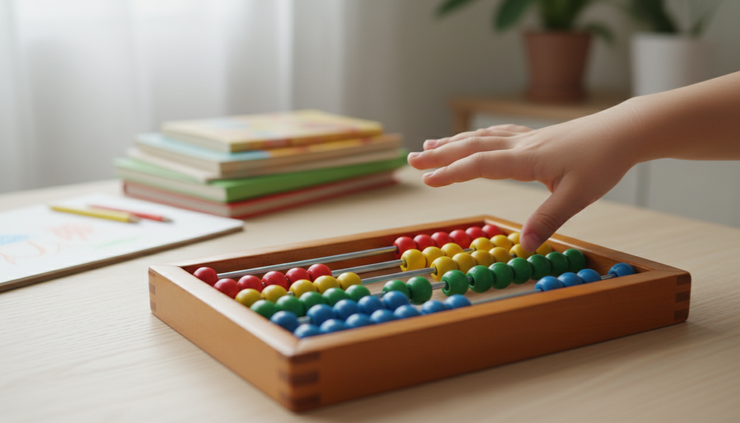
Some children benefit from seeing number patterns. An abacus, number line, hundred square, bead string or place value counters can make abstract ideas clearer.
Resources that often help include:
A hundred square for counting patterns and number bonds
Times table grids for spotting links
Number lines for addition and subtraction
Base ten blocks for place value
Coins for money calculations
Flashcards for quick recall
Whiteboards for low-pressure practice
Digital resources can help too, especially when they give instant feedback and adapt to the child’s level. Set a time limit so practice stays focused. Ten minutes is often enough.
Some families also choose structured support, such as abacus maths classes for kids, mental maths programmes, or small group tuition. These can be useful when children need a steady routine, guided practice and a different way to picture numbers.
How to keep practice positive at home
The way maths feels at home matters. Children notice adult reactions. If every wrong answer leads to tension, they may avoid trying. If effort gets noticed, they are more likely to persevere.
Praise specific behaviours:
“You checked that carefully.”
“You remembered the double and adjusted it.”
“You spotted your own mistake.”
“You kept going even when it felt hard.”
Avoid comparing siblings or classmates. A child who needs more time is not failing. They may simply need a smaller step, more practice with materials, or a different explanation.
It also helps to track progress visibly. Use a small chart for facts learned, not marks lost. Let children colour in a grid when they master a table or number bond set. Progress should feel earned and encouraging.
Know when to slow down
If a child keeps making the same mistakes, pause timed practice. Go back to concrete objects, drawings or simpler numbers.
For example, if 8 + 7 is difficult, practise:
8 + 2 = 10
10 + 5 = 15
8 + 7 = 15
If 6 × 7 is difficult, connect it to known facts:
5 × 7 = 35
One more 7 makes 42
So 6 × 7 = 42
Fluency grows when children see relationships. Repeating the same missed fact without a strategy often leads to more frustration.
Work with the school when needed
If concerns persist, speak to the class teacher. Ask which facts or methods the child should practise at home. Schools in the UK may use specific calculation policies, and matching their language can prevent confusion.
Useful questions include:
“Which number facts should we focus on first?”
“Is my child accurate when there is no time pressure?”
“Do they understand the method, or are they guessing?”
“What resources do you use in class?”
If a child finds maths unusually difficult despite regular support, the school can advise on next steps. Extra help works best when home and school share the same picture.
Frequently asked questions
Should children be timed when practising maths?
Timed practice can help once a child understands the facts and can answer accurately. If timing causes stress or guessing, remove the timer and build confidence first.
How much maths practice should children do at home?
Short, regular practice works well. Around 5 to 10 minutes on most days is often enough for fluency work, especially for primary school children.
What should I do if my child is accurate but very slow?
Look for strategies that reduce effort. Number bonds, doubles, near doubles and times table links can help. Practise a small set of facts until they become familiar.
What should I do if my child is fast but careless?
Build in checking habits. Ask them to estimate first, reread the question, and check one answer using another method. Praise careful correction, not only speed.
Are apps and online games useful?
They can be useful when they match the child’s level and give clear feedback. Balance screen practice with hands-on activities, talking through methods and real-life maths.

A confident next step for parents
Speed and accuracy grow through small, steady habits. Start with one area, such as number bonds, doubles or a times table. Practise for a few minutes. Keep the questions varied. Celebrate careful thinking. Add pace only when accuracy feels secure. Also Read our Blogs on:
If your child would benefit from a structured approach to number fluency, explore abacus and mental maths support for children. A clear routine and visual method can make practice feel more manageable.
The most helpful message a child can hear is simple: maths gets easier with the right practice. Build accuracy, then speed. Keep it playful. Keep it calm. Confidence will follow.


Comments