
Can Abacus Help Children Who Say “I’m Just Not Good at Maths”?
“I’m just not good at maths” can become a child’s shortcut for “I feel lost”, “I’m scared of getting it wrong”, or “everyone else seems faster than me”. Once that belief settles in, worksheets and quick-fire questions can feel like proof that maths is not for them.
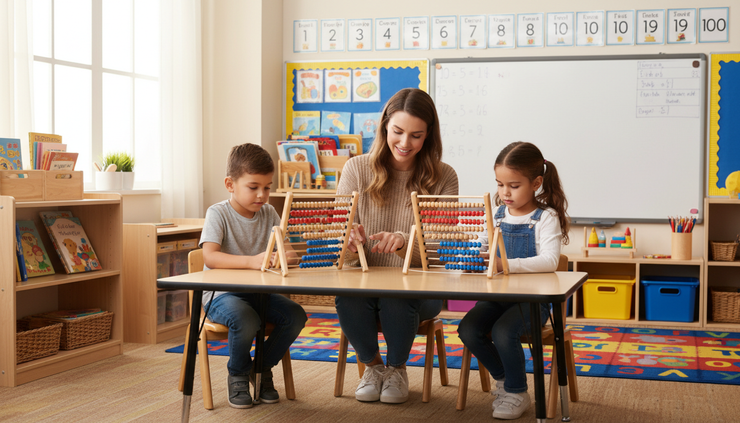
An abacus can change the experience. It gives children something to see, touch, move and control. Instead of staring at abstract numbers on a page, they can build numbers with beads, take them apart, compare them, and watch calculations happen in front of them.
That shift matters. For many children, confidence in maths grows when numbers stop feeling like a test and start feeling like objects they can handle.

Why some children believe they are “not good at maths”
Children rarely decide they dislike maths after one difficult sum. The feeling usually builds over time.
A child may struggle because they:
Lose track of numbers in their head
Rely on memorising steps without understanding them
Feel pressure to answer quickly
Confuse place value, such as tens and ones
Panic when a question looks different from the examples they have practised
Compare themselves with classmates who seem faster
The phrase “I’m just not good at maths” can be protective. It gives a reason to stop trying before embarrassment begins. The aim is not to argue with the child or insist that maths is easy. It is to give them a different experience of success.
The abacus helps because it slows maths down in a useful way. A child can watch each step. They can move one bead at a time. They can correct mistakes without rubbing out a whole page. Most of all, they can see that maths has structure.
For a child who feels anxious, this can be a relief. The beads do not rush them. They do not judge. They simply show what is happening.
How the abacus builds number sense
Good maths grows from number sense. That means understanding what numbers represent, how they relate to each other, and what changes during a calculation.
Many children can count aloud but still find numbers vague. They may know that 47 comes after 46, but not fully grasp that 47 is made of 4 tens and 7 ones. This gap can make addition, subtraction, multiplication and division feel like a chain of rules.
The abacus makes number structure visible.
It shows place value clearly
Place value is one of the biggest ideas in primary maths. It is also one of the easiest to misunderstand.
On a counting frame, beads can represent ones, tens, hundreds and beyond, depending on the type of frame and how it is taught. When a child moves beads to make 23, they can see that 23 is not just “two and three”. It is two tens and three ones.
That helps with calculations such as:
23 + 10
45 - 20
36 + 7
52 - 8
Instead of treating each as a separate trick, the child starts to see patterns. Adding 10 changes the tens. Adding 7 may involve making a ten first. Subtracting 8 may mean regrouping.
These actions become physical before they become mental.
It turns calculation into movement
A sum on paper can look static. Beads make it active.
For example, with 8 + 5, a child can begin with 8 beads, add 2 more to make 10, then add the remaining 3. They do not just hear “make ten” as a teacher’s instruction. They see and feel what making ten means.
This supports key skills such as:
Counting on and counting back
Regrouping numbers
Making tens
Understanding complements, such as 7 and 3 making 10
Recognising number bonds
Seeing why carrying and borrowing work
Over time, children may start to picture the beads without touching them. This is where abacus practice can link naturally with mental maths. The physical model becomes a mental image, and the child begins to calculate with more confidence.

Why tactile learning can build confidence
Some children learn best when they can use their hands. This does not mean they cannot think abstractly. It means movement helps them reach abstract thinking.
Tactile learning gives children more ways to process information. They are not only looking at numbers or listening to an explanation. They are touching, sliding, grouping and checking.
That can make a big difference for a child who has started to fear maths.
It reduces the fear of mistakes
With written maths, mistakes can feel permanent. A crossed-out answer may look like failure. With beads, a mistake is just a bead in the wrong place. The child can move it back and try again.
This makes practice feel safer.
A child who avoids maths may be willing to attempt a calculation on a counting frame because the task feels more like exploring than being tested. That first step matters. Confidence often grows from repeated small moments of “I can do this”.
It supports focus
The physical action of moving beads can help some children stay engaged. Their hands have a job to do, and their eyes can follow the calculation.
This is useful for children who find worksheets dull or overwhelming. A page of sums may look like too much. One calculation built with beads can feel manageable.
It gives immediate feedback
If a child adds 6 and 4 on a frame, they can see the group of 10. If they subtract and end up with too many beads, something looks wrong. The tool gives feedback without waiting for an adult to mark the answer.
That feedback builds independence. The child starts asking, “Does this make sense?” rather than “Is this right?”
It changes the child’s self-talk
Confidence is not built by praise alone. Telling a child “you’re clever” may feel good for a moment, but it does not always help when the next problem is hard.
What helps is evidence.
When a child can say:
“I made 10.”
“I know why I carried the 1.”
“I checked it myself.”
“I can show you how I got the answer.”
They begin to form a new identity around maths. Not “I am brilliant at everything”, but “I can learn this if I have a method.”
That is a stronger kind of confidence.
What parents and educators often notice
Every child is different, and an abacus is not a magic fix. Children still need patient teaching, regular practice and time to develop fluency. Yet many parents and educators describe similar changes when hands-on number work becomes part of learning.
The following examples are typical of what families and teachers often report when children use bead-based maths practice consistently.
“My child stopped guessing and started explaining. That was the biggest change. Even when the answer was wrong, I could see they were thinking.”
One parent might notice that their child no longer freezes at addition questions. Instead of saying, “I don’t know”, the child reaches for the beads and builds the problem. The answer may take longer at first, but the child is participating rather than shutting down.
A Year 3 teacher may see a quiet pupil become more willing to answer because they can show the calculation rather than explain it all verbally. For some children, demonstrating with beads feels less exposed than speaking in front of a class.
A tutor might find that a child who memorised number facts without understanding begins to spot relationships. For example, after practising 9 + 6 as 10 + 5, the child may start applying the same idea to 19 + 6 or 29 + 6.
These are not dramatic overnight transformations. They are small shifts that add up:
Before using hands-on support | After regular practice |
“I can’t do this.” | “Can I use the beads?” |
Counts every number from one | Starts grouping into tens |
Guesses quickly to escape the task | Slows down and checks |
Sees mistakes as failure | Moves the beads and tries again |
Memorises steps | Begins to explain why a method works |
Educators also value the way a counting frame reveals thinking. When a child writes “34 + 18 = 412”, the adult can see the answer is wrong, but not always why. When the child builds the sum with beads, the misunderstanding becomes visible. Perhaps they joined digits instead of adding values. Perhaps they missed the regrouping step.
That makes teaching more precise and less frustrating for everyone.
How parents can introduce the abacus at home
The best way to introduce a new maths tool is gently. If a child already feels anxious, presenting it as another thing they must master can backfire. Keep it playful, short and practical.
Start with exploration
Before teaching formal methods, let the child move the beads.
Ask simple questions:
“How many beads are on this row?”
“Can you move 5 beads?”
“Can you show me 7 another way?”
“What happens if we add 1 more?”
“Can you make the same number on a different row?”
This stage gives the child ownership. It also helps parents see what the child already understands.
Use familiar numbers first
Begin with numbers the child meets in everyday life. This keeps maths connected to reality.
Try examples such as:
Counting pieces of fruit
Sharing snacks
Adding pocket money
Counting days until the weekend
Working out how many more pages to read
Adding scores in a simple game
For example, if a child has 6 grapes and gets 3 more, they can move 6 beads, then 3 beads, then count the total. Later, they can learn to see 6 + 3 without counting each bead.
Keep sessions short
A tired or worried child does not need a long lesson. Five to ten minutes of calm practice can be more useful than a half-hour battle.
A simple routine might be:
Make a number together.
Change it by adding or subtracting a small amount.
Ask the child to explain what changed.
End with one question they can succeed at.
Stopping while the child still feels capable is powerful. It builds a positive memory for next time.
Praise the process
Focus on what the child did, not only the answer.
Helpful praise sounds like:
“You checked that carefully.”
“You found a way to make 10.”
“You noticed the tens changed.”
“You tried again when it looked wrong.”
“You explained your thinking clearly.”
This teaches the child that maths is about reasoning, not speed alone.
Move from concrete to mental images
At first, the child may need to touch every bead. That is fine. With practice, invite them to picture the movement before they do it.
For example:
“Before you move the beads, can you imagine what 8 plus 2 will look like?”
Then let them check. This bridges hands-on learning and mental calculation.
This is often where structured support can help. Some families choose abacus classes for kids, mental maths practice, or a mix of home activities and guided teaching to build consistency. The right approach depends on the child’s age, confidence and current understanding.
Avoid turning it into a race
Speed can come later. If a child already believes they are bad at maths, timed drills may confirm that fear. Accuracy, understanding and calm practice should come first.
Once the child feels secure, gentle fluency games can be useful. For example, ask how many ways they can make 10, or challenge them to show 15 in three different ways.
Connect it to school methods
Children can become confused if home methods feel completely separate from school learning. If possible, use the same language they hear in class, such as tens and ones, number bonds, regrouping, add, subtract and difference.
The beads should support school maths, not replace it.
FAQ
What age is best to start using an abacus?
Many children can begin simple bead counting in the early primary years. Formal methods can come later, once they understand counting, grouping and basic addition. The key is to match the activity to the child’s stage rather than their age alone.
Can an abacus help a child who hates maths?
It can help, especially if the child feels anxious because numbers seem too abstract. A hands-on tool can make maths feel more manageable. It works best with patience, short sessions and encouragement.
Will my child become dependent on it?
Not if it is used well. The aim is to move from touching beads, to picturing beads, to calculating mentally. Like number lines or counters, it is a bridge towards stronger understanding.
Is it only useful for addition and subtraction?
No. It can also support place value, number bonds, multiplication patterns, division, regrouping and mental calculation. Start with simple operations, then build gradually.
Do parents need to be good at maths to use it at home?
No. Parents can start with counting, making numbers and simple sums. The most useful role is to stay calm, ask questions and encourage the child to explain what they see.

A small tool can create a big shift
A child who says “I’m just not good at maths” is often asking for a safer way in. The abacus classes offers that by making numbers visible, touchable and less mysterious. It helps children slow down, spot patterns, understand place value and build calculations step by step. Also Read our Blogs on:
The real goal is not to create a child who can move beads quickly. The goal is to help a child think, reason and trust that they can learn.
For families who want structured support, explore abacus and mental maths learning for children and see how guided practice can help turn uncertainty into steady confidence.


Comments