
Is the Abacus Still Relevant in the Age of Calculators and AI
A calculator can give an answer in a second. An AI tool can explain the steps, generate practice questions, and check working. So why would anyone still care about a frame of rods and beads?
Because the Abacus does something digital tools often skip. It makes number visible, touchable, and spatial. It turns arithmetic into a physical action. For learners, that can be the difference between copying a method and actually understanding what is happening.
The Abacus is not a rival to calculators or AI. It is a different kind of tool. Its value lies less in speed alone and more in the way it builds number sense, concentration, and mental calculation skills.

The Abacus has lasted because it solves a real problem
The Abacus is one of the oldest calculating tools still recognisable today. Variations appeared across ancient cultures, including Mesopotamia, Greece, Rome, China, Japan, and other parts of Asia and Europe. The designs varied, from counting boards with stones to bead frames, but the purpose stayed steady: help people count, trade, measure, and calculate reliably.
That history matters. Before written algorithms became common, people needed practical ways to manage quantities. Merchants counted goods. Builders measured materials. Tax collectors recorded payments. Families planned stores of food. The Abacus helped people handle numbers in a world without screens, batteries, or printed worksheets.
The best-known forms today include the Chinese suanpan and the Japanese soroban. Both use beads placed on rods, with different bead arrangements. The basic idea is simple: bead positions represent values. Move the beads, and the number changes.
That physical structure gives the Abacus its power. Place value, carrying, borrowing, addition, subtraction, multiplication, and division can all be shown through motion. A child can see why ten ones become one ten. A learner can feel regrouping rather than only hearing about it.
This is one reason the Abacus has not disappeared. It is not only a tool for getting answers. It is a tool for seeing how numbers behave.
Calculators answer quickly, but they do not always teach
Calculators are brilliant at what they do. They reduce errors in long calculations, save time, and support complex work in science, engineering, finance, and everyday life. No one needs to use an Abacus to total a supermarket receipt or work out a mortgage estimate.
Digital calculators also make mathematics more accessible. They allow learners to focus on problem solving rather than getting stuck on arithmetic. In secondary school and beyond, this matters. A calculator can free up attention for algebra, statistics, geometry, and modelling.
Yet calculators have a weakness. They can hide the process.
Type `47 + 38`, press equals, and the answer appears. The tool does not require any understanding of place value. It does not ask whether 7 plus 8 bridges through 10. It does not make the learner notice that 40 plus 30 and 7 plus 8 are separate parts of the same problem.
For confident users, that is fine. For learners still forming number sense, it can become a problem. They may accept whatever appears on the screen without estimating or checking whether the answer is reasonable.
The Abacus slows the process down in a useful way. To add 47 and 38, the learner must represent 47, add 30, then add 8, often involving a regrouping step. The answer is not just displayed. It is constructed.
That construction helps build what teachers often call number flexibility. Learners begin to recognise patterns:
Ten ones can become one ten.
Five can act as a useful anchor.
Numbers can be split and recombined.
Addition and subtraction are linked.
A result should make sense before it is accepted.
A calculator is faster for output. An Abacus can be stronger for understanding.

AI can explain maths, but hands-on learning still matters
AI adds a new layer to the comparison. Unlike a basic calculator, an AI tool can explain a method, offer hints, show worked examples, and adapt practice questions. Used well, it can support independent learning.
For example, a pupil stuck on subtraction with regrouping might ask an AI tool for a simpler explanation. The tool could break the method into steps, draw a number line in text, or suggest easier examples. That can be genuinely helpful.
But AI still has limits. It is screen-based. It can produce errors. It may give an answer too soon. It can also create a passive learning habit if the learner asks for solutions instead of thinking through the problem.
The Abacus works in the opposite direction. It demands participation. Beads must be moved. Quantities must be held in attention. Mistakes become visible because the bead pattern does not match the intended number.
This is not a small point. Many people learn better when they combine vision, touch, speech, and movement. The Abacus supports that mix. A child can say the number aloud, move the beads, see the structure, and then write the answer. That multi-sensory loop can make arithmetic less mysterious.
AI can be an excellent tutor. The Abacus can be an excellent training ground. Together, they could even complement each other. A learner might practise with an Abacus, then use an AI tool to ask why a particular bead movement works. One builds experience. The other can add explanation.
The key is to match the tool to the task. If the goal is fast computation, use a calculator. If the goal is feedback and guided practice, AI may help. If the goal is strong mental models of number, the Abacus still has a place.
Where the Abacus still helps today
The Abacus is most relevant when the aim is not just to calculate, but to develop the mind behind the calculation.
Early maths education
In primary education, abstract symbols can arrive before children fully grasp what they mean. A worksheet may show `23 + 9`, but the child may not yet understand 23 as two tens and three ones.
An Abacus bridges that gap. It lets learners build numbers from parts. It also makes base-ten structure clearer. When learners move beads to form numbers, they begin to recognise the difference between digit and value. The 2 in 23 is not just a mark on a page. It means two tens.
This is why some families explore Abacus classes for kids as a way to strengthen number confidence outside normal school lessons. The appeal is not nostalgia. It is the practical benefit of making arithmetic concrete.
Mental maths training
With enough practice, many Abacus learners begin to picture the bead movements in their minds. This is often called mental Abacus. Instead of relying on the physical frame, they visualise it and perform calculations mentally.
This can support speed, memory, and focus. It also encourages learners to break numbers apart and recombine them. In that sense, Abacus maths, mental maths practice can help learners move from counting to calculating.
For example, adding 56 and 27 on an imagined Abacus involves seeing 56, adding 20, then adding 7. The learner may need to exchange beads mentally, which strengthens working memory and place value awareness.
Building attention and patience
Digital tools often reward quick taps. The Abacus rewards careful sequence. Move the wrong bead, and the answer changes. Skip a step, and the structure breaks.
That makes it useful for developing concentration. Learners practise following a process, checking each stage, and correcting errors. These habits matter far beyond arithmetic.
Reducing screen dependence
Many parents and teachers want useful learning tools that do not involve more screen time. The Abacus gives children a way to practise maths with their hands and eyes, without notifications, pop-ups, or auto-complete answers.
That does not make screens bad. It simply gives learners a different mode of attention.
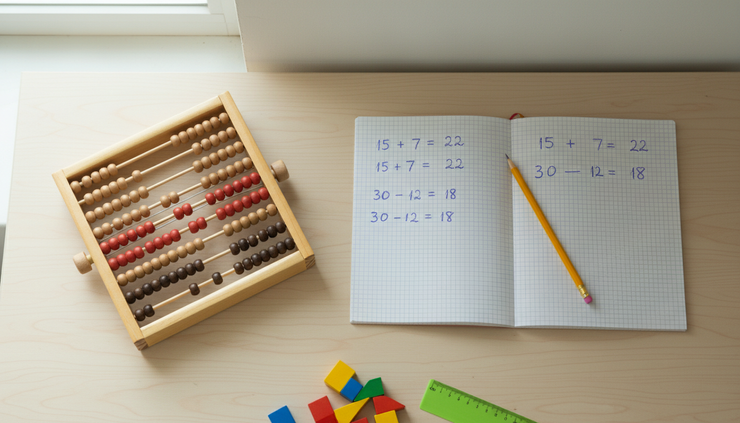
What the Abacus does better than digital tools
The Abacus is not better at everything. It will not replace scientific calculators, spreadsheets, coding tools, or AI tutors. Its advantages are more specific.
Abacus | Digital calculator or AI |
Shows number as a physical structure | Shows results on a screen |
Encourages step-by-step thinking | Can skip straight to an answer |
Builds place value through movement | Assumes place value is already understood |
Works without power or internet | Needs a device, battery, or connection |
Supports mental imagery with practice | Supports explanation and automation |
Encourages estimation and checking | May invite answer-copying |
The Abacus has several unique strengths.
It makes place value visible.
A bead in one column means something different from a bead in another column. This helps learners understand why digits change value depending on position.
It creates a memory image.
Repeated practice can lead to a strong mental picture of number. Learners may start to “see” quantities rather than count from scratch.
It gives instant physical feedback.
If the beads do not match the intended number, the learner can spot the error. The tool does not need to mark the answer. The structure itself gives clues.
It encourages active effort.
A calculator can be used passively. AI can be used passively. An Abacus cannot. The learner has to do the work.
It is simple and durable.
No battery. No update. No subscription. A well-made Abacus can last for years.
These qualities are easy to overlook because they are not flashy. Yet they are exactly what make the Abacus useful in a world full of automated answers.
The best role for the Abacus is not replacing technology
The question is not whether the Abacus can beat AI. It cannot generate explanations in natural language. It cannot graph a function, solve a large system of equations, or check pages of work in seconds.
The better question is where the Abacus fits in a healthy learning journey.
A sensible progression might look like this:
Use physical tools, including fingers, counters, number lines, and the Abacus, to build number meaning.
Move towards mental strategies as patterns become familiar.
Use written methods to record thinking clearly.
Use calculators for efficiency once the underlying ideas are secure.
Use AI for explanation, practice, revision, and extension, while still checking its output.
This order matters. When learners meet automation too early, they may become dependent on it. When they meet concrete tools first, technology becomes a support rather than a crutch.
For adults, the Abacus can also be surprisingly refreshing. It offers a different way to engage with arithmetic. It can sharpen estimation skills and reveal gaps hidden by years of calculator use. It may even appeal to people who enjoy puzzles, memory training, or the history of technology.
The Abacus is a reminder that progress does not always mean abandoning older tools. Sometimes an older tool survives because it teaches something newer tools cannot easily replace.
Frequently Asked Questions
Is the Abacus still used in schools?
Yes, in some schools and learning programmes, especially for early arithmetic and mental calculation practice. It is not a standard tool everywhere in the UK, but it remains popular in many maths enrichment settings.
Can an Abacus help with mental maths?
Yes. With regular practice, learners can internalise bead movements and use a mental image of the Abacus to calculate. This can support speed, accuracy, and number confidence.
Is the Abacus better than a calculator?
Not for fast complex calculations. A calculator is better for speed and convenience. The Abacus is better for showing how numbers work and helping learners build strong arithmetic foundations.
What age is best to start learning the Abacus?
Many children start during primary school, once they can recognise numbers and follow simple counting patterns. The best age varies, but the early years of formal maths learning are often a good time.
Does learning the Abacus help with modern technology skills?
Indirectly, yes. It develops logical thinking, pattern recognition, attention, and number sense. These skills support later learning in coding, data, science, and technology.
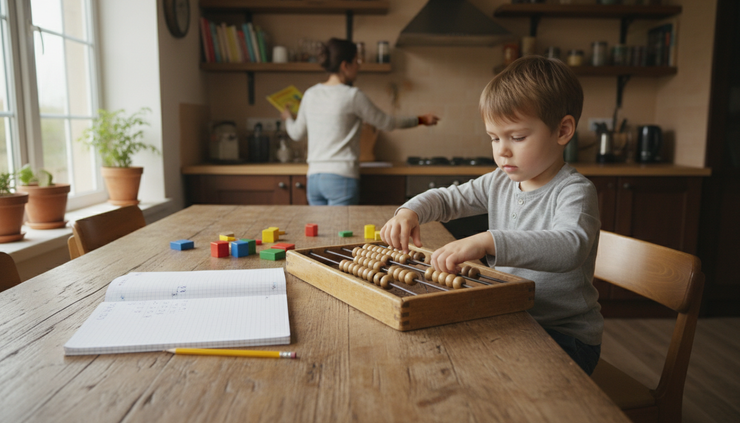
The Abacus still earns its place
The Abacus remains relevant because it teaches number in a way screens rarely do. It turns arithmetic into something learners can see, touch, and remember. Calculators and AI are powerful, but they are strongest when people already have the judgement to use them well.
For anyone interested in building stronger number foundations, especially for children, the Abacus is still worth a serious look. To explore structured learning, see this guide to Abacus and mental maths for kids.
The future of maths learning does not have to choose between beads and algorithms. The smartest approach uses both, with each tool doing what it does best.


Comments