
Boost Kids Mental Maths Speed and Accuracy with Fun Daily Practice Tips
- Emma Williams
- 6 days ago
- 8 min read
A child who pauses over “8 + 7” is not slow. They may simply be using a method that asks their brain to work too hard.
Fast, accurate calculation grows from patterns, memory, confidence and good habits. The aim is not to rush children or turn maths into a race every day. The aim is to help them recognise numbers, choose smart shortcuts and check their answers without stress.
The best routines are short, playful and regular. Five to ten focused minutes can do more than a long worksheet done with tired eyes. With the right mix of games, memory tricks, visualisation and careful checking, children can build stronger number sense and feel proud of their progress.
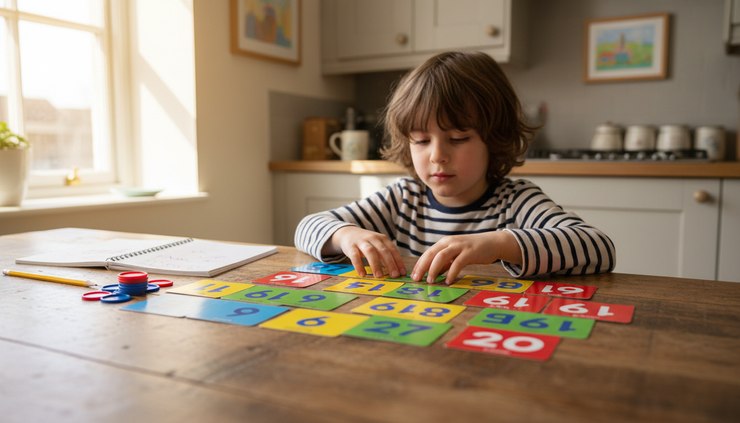
Build a daily routine that feels easy to start
Children improve fastest when practice becomes familiar. A routine removes the “What should we do today?” problem and makes maths feel normal, like reading a few pages before bed.
Keep practice short. A good session can last 10 minutes:
Time | Activity | Example |
2 minutes | Warm up | Count forwards and backwards in 2s, 5s or 10s |
3 minutes | Number facts | Practise pairs that make 10, 20 or 100 |
3 minutes | Strategy game | Add 9 by adding 10, then taking 1 away |
2 minutes | Quick check | Explain one answer out loud |
This routine works because it balances speed with understanding. Children are not just recalling answers. They are learning why those answers make sense.
Try the five-a-day challenge
Choose five quick questions each day. Keep them at the right level, so the child can succeed with effort.
For younger children:
6 + 4
9 + 2
10 - 7
Double 5
12 - 2
For older children:
18 + 7
35 + 20
46 - 9
6 × 7
Half of 84
Ask the child to sort the questions into three groups:
I knew it straight away
I used a strategy
I need to practise this one
That simple sorting step builds self-awareness. It also shows which skills need attention without making errors feel like failure.
Use the same Mental Maths skill in different ways
If the target is “make 10”, practise it with objects, spoken questions and written sums.
For example:
Show 7 counters and ask, “How many more make 10?”
Say, “I have 6. What do I need to reach 10?”
Write `8 + __ = 10`
Ask, “What is 10 - 3?”
This helps children connect addition and subtraction, rather than treating every sum as a separate fact to memorise.

Use memory techniques that make numbers stick
Some number facts need to become automatic. If a child has to work out every small fact from scratch, larger calculations feel slow and tiring.
Memory improves when facts are connected to patterns, stories and rhythm.
Learn number bonds as families
Number bonds are pairs of numbers that make a target number. The most useful early targets are 10, 20 and 100.
For 10:
0 + 10
1 + 9
2 + 8
3 + 7
4 + 6
5 + 5
A child who knows these well can solve many sums faster. For example, `8 + 6` becomes easier when they think:
“I need 2 to make 10. I take 2 from the 6. That leaves 4. So 8 + 6 = 14.”
This is called bridging through 10, and it is one of the most useful mental strategies children can learn.
Turn tricky facts into mini stories
Stories help when a fact refuses to stick.
For example, `7 × 8 = 56` is often tricky. A well-known memory line is:
“Five, six, seven, eight. 56 is 7 times 8.”
Children can also create their own lines. The sillier the better, as long as the fact stays clear.
For `9 + 6 = 15`, they might say:
“9 is hungry for 1, so it takes 1 from 6 and becomes 10. Then 5 is left. 10 + 5 = 15.”
That story supports the strategy, not just the answer.
Use rhythm and call back
Chanting can help with multiplication facts, especially when it has a beat. Try clapping:
“Three, six, nine, twelve, fifteen, eighteen…”
Then pause and ask:
“What comes after 18?”
This is better than reciting the whole table every time. It teaches children to enter the pattern at different points.
Play the hidden pair game
Write numbers from 0 to 10 on scraps of paper. Turn them face down. The target is 10.
A child turns over two cards. If they make 10, they keep the pair. If not, they turn them back over. This practises memory and number bonds at the same time.
To make it harder, use numbers that pair to 20, 50 or 100.
Help children see numbers in their mind
Good calculators do not always “hear” numbers as spoken words. They often “see” them. Visualisation helps children hold numbers in working memory and avoid losing track halfway through a sum.
This is where tools can help. Beads, counters, ten frames, number lines and fingers can all support a child before they move towards doing more in their head. Some families also explore abacus maths, finger maths and other structured methods to develop quick number images.
Use a mental number line
A number line helps children picture movement.
For `27 + 8`, they can think:
Start at 27
Jump 3 to reach 30
Jump 5 more
Land on 35
So `27 + 8 = 35`.
Draw it first. Then ask the child to close their eyes and imagine the jumps. After a while, they will not need to draw every step.
Try these:
46 + 7
58 + 5
73 + 9
31 - 6
82 - 8
The key question is, “What friendly number did you use?” Friendly numbers are easy stopping points, such as 10, 20, 50 or 100.
Picture hundreds, tens and ones
Place value becomes clearer when children imagine numbers in parts.
For `64 + 23`, think:
64 is 6 tens and 4 ones
23 is 2 tens and 3 ones
6 tens + 2 tens = 8 tens
4 ones + 3 ones = 7 ones
Answer: 87
This makes the calculation less crowded. Instead of juggling two full numbers, the child works with tens and ones.
Try the “screen in your mind” exercise
Ask the child to imagine a small screen in their head. Give them a number, such as 48. Then ask them to change it:
Add 10. What do you see?
Take away 5. What do you see?
Add 20. What do you see?
Make it the next multiple of 10. What do you see?
This strengthens mental tracking. It also helps children notice when an answer looks wrong.

Reduce calculation errors with simple checking habits
Speed only helps if the answer is right. Accuracy improves when children learn to slow down at the right moments, not all the time.
Many mistakes come from one of four places:
Misreading the question
Forgetting a carried or exchanged number
Mixing up operation signs
Giving an answer that is too big or too small
A few habits can prevent most of these.
Say the operation before solving
Before answering, the child says:
“I am adding.”
“I am subtracting.”
“I am multiplying.”
This takes one second, but it stops many sign errors. It is especially helpful when a page mixes different question types.
Estimate before calculating
Estimation gives the brain a target zone.
For `49 + 32`, a child might think:
“49 is close to 50. 32 is close to 30. The answer should be about 80.”
Then if they calculate 61 or 98, they know to check again.
Try this format:
Exact question: `68 - 29`
Estimate: “About 70 - 30, so about 40”
Solve: `68 - 30 = 38`, then add 1 back, so `39`
Check: 39 is close to 40, so it makes sense
Use the reverse operation
Addition and subtraction check each other.
If `36 + 27 = 63`, check with:
`63 - 27 = 36`
Multiplication and division work the same way.
If `8 × 6 = 48`, check with:
`48 ÷ 6 = 8`
This is a powerful habit because it gives children a way to prove their own answer.
Keep working memory clear
Some children make mistakes because they try to hold too much in their head at once. That does not mean they cannot do maths. It means they need cleaner steps.
For `56 + 38`, try:
Add 30 to 56 to get 86
Add 8 to get 94
Or:
56 + 40 = 96
Take away 2
Answer: 94
Both strategies are valid. The best one is the one the child can explain clearly.
Make mistakes useful
When an answer is wrong, ask calm questions:
“Where did the number change?”
“Did the answer get bigger or smaller?”
“Does that match the sign?”
“Can you solve it another way?”
Avoid asking, “Why did you get it wrong?” That can sound like blame. A better question is, “Which part should we check?”
Exercises that make practice feel like play
Children practise more willingly when there is a game shape. These exercises need very little equipment.
Beat your own time
Pick 10 facts the child nearly knows. Time how long it takes to answer them accurately. Repeat the same set later in the week.
The goal is not to beat someone else. The goal is to beat yesterday’s personal best while keeping accuracy high.
Use this rule:
No new speed record counts unless all answers are correct.
Number target
Choose a target number, such as 24. Give the child four numbers:
`2, 3, 5, 10`
Can they make 24?
Possible answer:
`10 + 5 = 15`
`15 × 2 = 30`
`30 - 3 = 27`
Not there yet, so try again.
Another route:
`5 - 3 = 2`
`10 + 2 = 12`
`12 × 2 = 24`
This builds flexible thinking. It also shows that maths can involve trial, adjustment and creativity.
Shopkeeper maths
Use pretend prices in pounds and pence.
A banana costs 30p
A drink costs 85p
A snack costs £1.20
Ask:
“How much for two bananas?”
“How much for a drink and a snack?”
“If I pay with £2, how much change do I get from £1.20?”
Money examples feel useful and familiar, especially for children in the UK who see pounds and pence in daily life.
The quiet minute
Set a timer for one minute. Give the child a question such as:
`25 + 18`
They must solve it silently, then explain their thinking afterwards.
This separates calculation from explanation. It helps children notice the steps they used and gives adults a chance to praise the strategy, not only the answer.
Frequently Asked Questions
How long should children practise each day?
Five to ten minutes is enough for most children. Short daily practice usually works better than one long session at the weekend.
What age should children start mental calculation practice?
Children can start simple number games in the early primary years. Counting, matching pairs to 10 and doubling small numbers are all useful first steps.
Should children memorise times tables or focus on strategies?
They need both. Memory gives speed, while strategies help when a fact is forgotten or when numbers become larger.
What should I do if my child gets anxious about timed maths?
Remove the timer for a while. Focus on accuracy, patterns and explaining strategies. Bring back timing only as a personal challenge, not a test.
How can I tell if practice is working?
Look for clearer explanations, fewer small errors and quicker recall of familiar facts. Confidence is a sign of progress too.
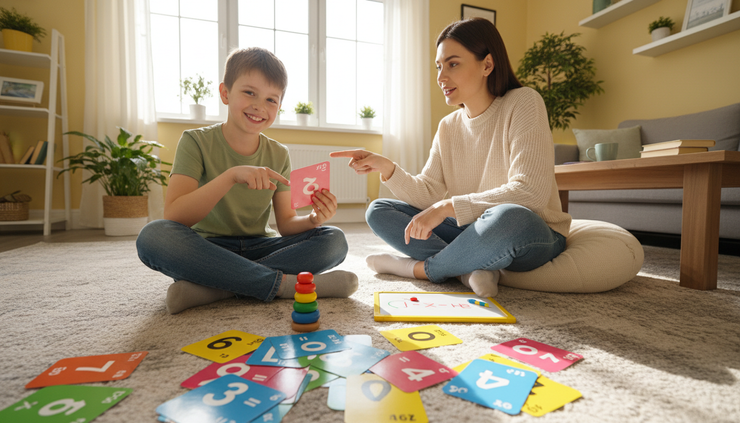
Keep progress steady and positive
Fast calculation is built in layers. Children need strong number bonds, clear visual images, reliable checking habits and regular practice that feels safe.
A helpful week might look like this:
Monday Number bonds to 10 or 20
Tuesday Doubles and near doubles
Wednesday Adding and subtracting 9 or 11
Thursday Times table patterns
Friday Money or shopkeeper maths
Weekend A short game, puzzle or family challenge
Keep praise specific. Instead of “You’re so clever,” try:
“You spotted the number bond quickly.”
“You checked your answer in a smart way.”
“You changed strategy when the first one felt hard.”
That kind of praise teaches children what to repeat.
For a more structured approach to building calculation confidence, explore this guide to abacus mental maths for kids. Also Read our Blogs on:
The best next step is simple: choose one routine, one memory trick and one checking habit. Practise them for a week. When children see that small daily effort leads to quicker, more accurate answers, maths starts to feel less like pressure and more like a skill they can grow.


Comments