
Abacus vs Mental Maths Key Differences Benefits and Which to Learn First
A child can solve `47 + 28` in more than one good way. One might move beads on an Abacus. Another might think, “47 plus 20 is 67, then plus 8 is 75.” Both routes lead to the same answer, but they train the mind in different ways.
That is why the comparison between Abacus and Mental Maths matters. They are often spoken about together, especially in children’s maths learning, yet they are not the same method. Abacus starts with a physical tool. Mental Maths happens in the mind, using number sense, memory, patterns and strategies.
Many parents in the UK come across both when looking at extra maths support, enrichment classes or confidence-building activities. The right choice is easier when the differences are clear.

What Abacus and Mental Maths mean in practice
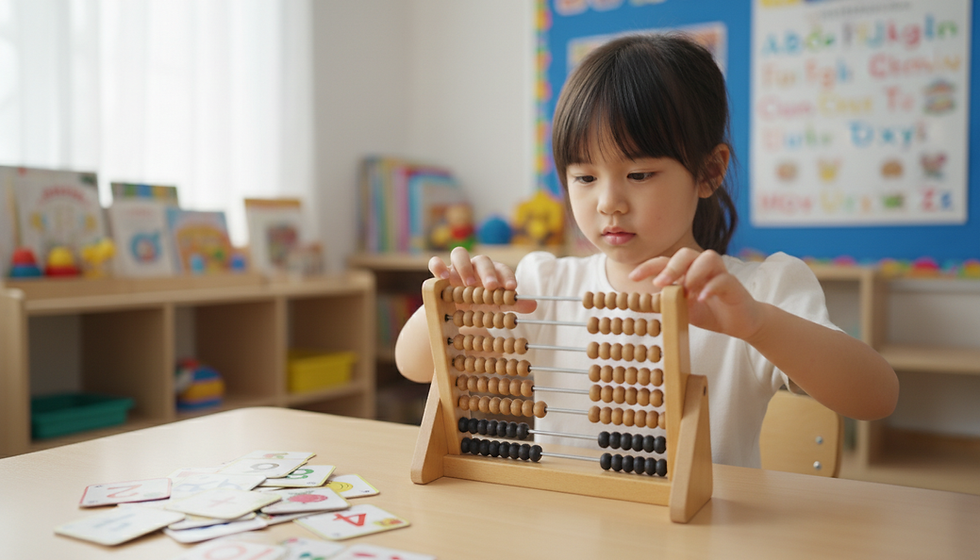
Abacus Maths uses a counting frame with rods and beads. Children move the beads to represent numbers and perform calculations. In many modern Abacus programmes, learners begin with a real Abacus and later imagine the bead movements in their mind.
For example, on a common soroban-style Abacus, one bead in the upper deck may represent 5, while lower beads represent 1 each. To show 7, a child moves one 5-bead and two 1-beads. This makes place value visible. Tens, hundreds and units are separated by columns, so numbers become something the child can build and adjust.
Mental Maths is broader. It means solving calculations without writing out the full method or using a calculator. A child might use number bonds, times table recall, doubling, halving, rounding or partitioning.
Take `99 + 36`.
A Mental Maths strategy might be:
Change 99 to 100
Add 36 to make 136
Subtract 1
The answer is 135
There is no bead movement here. The child uses a flexible number strategy.
Abacus can become mental too, because experienced learners often picture the Abacus in their head. This is sometimes called using a mental Abacus. That is one reason the two methods can be confused. Still, the starting point is different.
Abacus begins with seeing and touching numbers. Mental Maths begins with thinking about number relationships.
The key differences between Abacus and Mental Maths
The biggest difference is the way each method represents numbers.
Abacus is visual and physical. A child sees the number as beads. Mental Maths is internal. The child works with numbers in memory, using shortcuts and known facts.
Here is a simple comparison.
Feature | Abacus | Mental Maths |
Main tool | A bead frame, then a mental image of it | The learner’s own number sense and memory |
Best for | Place value, concentration, visual calculation | Flexibility, everyday calculation, mathematical reasoning |
Learning style | Structured and step-by-step | Strategy-based and varied |
Example method | Move beads to add 38 and 24 | Partition 38 into 30 and 8, then add in parts |
Early focus | Accuracy through representation | Speed and flexibility through patterns |
Abacus often follows a set sequence. Children learn how to hold numbers on the frame, how to add and subtract, then how to handle carrying and borrowing. This structure can be reassuring. There is a clear “do this, then this” flow.
Mental Maths can feel less fixed. There are usually several valid methods. For `25 × 16`, one child might double and halve:
25 × 16
50 × 8
100 × 4
400
Another might think:
25 × 10 = 250
25 × 6 = 150
250 + 150 = 400
Both are correct. Good Mental Maths encourages children to choose a method that fits the numbers, rather than forcing one method every time.
That flexibility is powerful, but it can also be harder for some learners at first. If a child does not yet understand place value or number bonds, Mental Maths strategies can feel like tricks. Abacus can help because it shows what is happening.

The benefits of learning with an Abacus
The Abacus is especially useful because it makes abstract maths concrete. Children do not just hear that 10 ones make 1 ten. They can see beads grouped by place value and move from one column to another.
This can help with several core skills.
It strengthens place value
Place value is one of the foundations of primary maths. Without it, children may see 304 as “3, 0 and 4” rather than 3 hundreds, 0 tens and 4 ones.
An Abacus separates columns clearly. This helps children understand why 9 becomes 10, why carrying happens, and why borrowing changes a neighbouring column.
It builds concentration
Using an Abacus requires careful attention. The child must move the correct beads in the correct direction and keep track of the number shown. This can support focus, especially when lessons are short, clear and consistent.
It supports visual memory
Over time, children may stop relying on the physical Abacus and start picturing it. For some learners, this mental image becomes a strong internal calculation tool.
For example, if asked to solve `63 - 28`, a trained child may imagine 63 on the Abacus, then remove 20 and 8 using bead movements. The calculation becomes a moving picture, not just spoken numbers.
It can make maths feel less intimidating
Some children feel anxious when faced with written sums. A hands-on tool can lower that pressure. Moving beads gives them something to do, which can make the task feel manageable.
The Abacus does have limits. If teaching focuses only on speed, children may perform procedures without understanding why they work. The best Abacus learning includes conversation: “What number is this?”, “Why did we exchange those beads?”, “Can you explain the change?”
That is where Abacus and wider maths teaching should connect.
The benefits of Mental Maths
Mental Maths is essential for daily life and school learning. It helps children estimate, check answers and solve problems efficiently.
A child in a shop might need to know whether £5 is enough for items costing £1.80 and £2.40. They do not need a written column method. They need a quick sense that £1.80 + £2.40 is £4.20, leaving 80p.
Mental Maths supports that kind of thinking.
It improves number flexibility
Strong Mental Maths helps children break numbers apart and rebuild them. This is useful in almost every area of maths.
For `48 + 27`, a child might think:
48 + 2 = 50
27 becomes 25
50 + 25 = 75
This shows more than speed. It shows that the child understands how numbers can be adjusted while keeping the value balanced.
It helps with estimation
Estimation is an underrated skill. Before solving `198 × 4`, a child can think, “That is close to 200 × 4, so the answer should be close to 800.” The exact answer is 792.
This helps children spot unreasonable answers. If they calculate 198 × 4 and get 7,902, estimation tells them something has gone wrong.
It supports confidence in school maths
In UK classrooms, children often need to answer quick questions, follow teacher explanations and check their own work. Mental Maths helps them keep up with the flow of lessons.
It also supports written methods. A child completing long multiplication still needs quick recall of number facts. Written work becomes easier when basic addition, subtraction and times tables do not overload working memory.
It encourages reasoning
Mental Maths is not just fast arithmetic. A good teacher might ask, “How did you know?” or “Can you find another way?” That turns a calculation into a reasoning task.
For example, to solve `15 × 18`, a child might say:
15 × 20 = 300
15 × 2 = 30
300 - 30 = 270
This shows understanding of adjustment, multiplication and subtraction in one neat strategy.

Which method is usually taught first
In a structured Abacus programme, Abacus is usually taught first. That is because learners need to understand the physical bead system before they can imagine it. The path often looks like this:
Learn numbers on the real Abacus
Practise simple addition and subtraction with bead movements
Build speed and accuracy
Visualise the Abacus without touching it
Solve calculations mentally using the imagined bead frame
This order makes sense. Children move from concrete to visual to mental. That matches how many young learners develop mathematical understanding.
In general school maths, the order is a little different. Children often start with concrete objects, such as counters, cubes, fingers and number lines. They then move towards pictorial methods and written or mental strategies. So even when schools do not use an Abacus, they still tend to begin with hands-on number work before fully abstract Mental Maths.
For younger children, the Abacus can be a helpful bridge. It gives structure before speed. It also reduces the need to hold everything in memory too soon.
By contrast, older children who already understand place value may not need a long Abacus foundation. They may benefit more from Mental Maths strategies, especially if their goal is quicker everyday calculation, stronger estimation or better test confidence.
A useful rule is:
Teach the representation before expecting speed. A child who understands the number will calculate more confidently than one who only memorises steps.
Many families compare abacus maths classes and mental maths classes for kids because they want both accuracy and confidence. The best choice is often not one against the other. It is the right sequence for the child’s stage.
How to choose the right approach
The better method depends on the learner’s current needs.
Choose Abacus first when a child:
Struggles with place value
Benefits from hands-on learning
Loses track during multi-step sums
Enjoys visual patterns and structured practice
Needs a clear foundation for addition and subtraction
Choose Mental Maths practice when a child:
Understands place value but calculates slowly
Needs stronger recall of number facts
Wants to improve estimation
Gets stuck using only one written method
Is ready to compare different strategies
For many children, the strongest route is a blend. Abacus develops a clear image of number. Mental Maths develops flexible thinking. Together, they can support both accuracy and independence.
Here is a simple example.
To solve `56 + 37`, an Abacus learner might picture 56, add 30, then add 7 through bead movements.
A Mental Maths learner might think:
56 + 40 = 96
96 - 3 = 93
Both methods work. The richer question is, “Can the child explain why the answer is 93?” If yes, the method is doing its job.
If you are exploring structured support, this guide to Abacus and Mental Maths for kids explains how the two approaches can work together.

Frequently asked questions
Is Abacus better than Mental Maths?
Abacus is better for making numbers visible and building structured calculation skills. Mental Maths is better for flexible thinking and quick everyday problem-solving. Many learners benefit from both.
What age is best to start Abacus?
Many children start Abacus during the primary years, once they can recognise numbers and follow simple instructions. The exact age matters less than readiness, attention span and interest.
Can Abacus improve Mental Maths?
Yes, it can. Once children learn to picture the Abacus, they may use that image to calculate mentally. This works best when lessons also explain the maths behind the bead movements.
Does Mental Maths mean doing sums as fast as possible?
No. Speed can be useful, but understanding matters more. Good Mental Maths includes choosing sensible strategies, estimating and explaining how an answer was found.
Should a child learn Abacus if they already do well in maths?
They can, especially if they enjoy patterns and mental challenges. Still, a confident child may gain just as much from rich Mental Maths problems, puzzles and reasoning tasks.
The main takeaway
Abacus and Mental Maths are closely linked, but they are not the same. Abacus gives children a concrete and visual model of number. Mental Maths helps them use number relationships quickly and flexibly. Also Read our Blogs on:
For beginners, Abacus is often taught first because it builds a clear foundation. Once children understand the bead system, they can move towards visualisation and mental calculation. For children who already have strong place value, Mental Maths can deepen reasoning and improve everyday confidence.
The strongest maths learning does not treat methods as rivals. It helps children see numbers, understand numbers and then work with them in the way that makes the most sense.


Comments