
Abacus Classes for Children: 7 Questions Parents Should Ask Before Enrolling
Many children can memorise number facts, yet still feel unsure about what numbers mean. That is often where Abacus learning attracts interest. It gives children something they can see, touch, move, and later picture in their mind.
For some children, Abacus lessons can build speed, focus, and confidence in maths. For others, a different approach may suit them better. The aim is not to rush into a class because it sounds impressive, but to understand whether it fits the child’s age, temperament, learning style, and current maths needs.
This guide explores the benefits of Abacus skills, the limits of Abacus education, and the seven questions parents should ask before enrolling.

What children can gain from learning Abacus skills
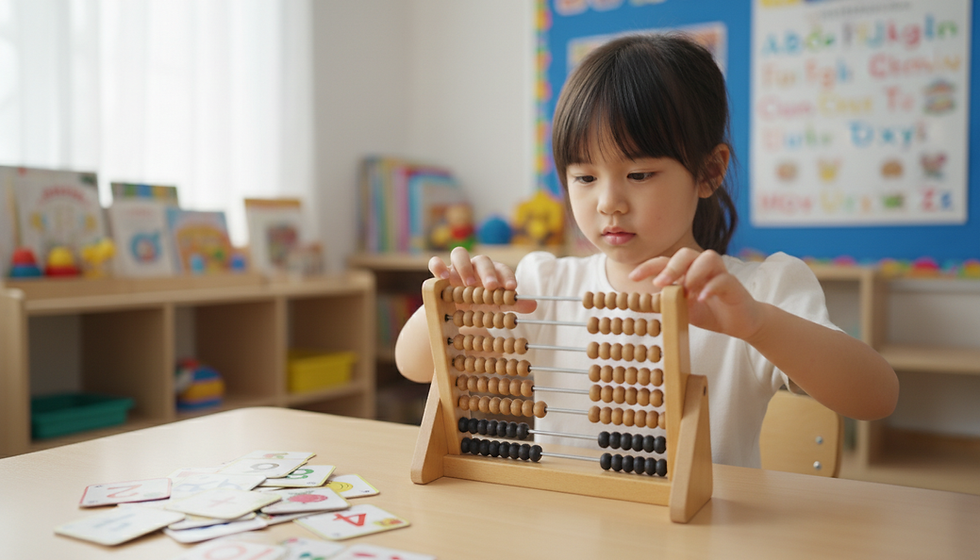
An Abacus is not just a counting frame. In a good class, it becomes a bridge between physical number work and mental calculation. Children start by moving beads, then gradually learn to visualise the Abacus in their mind.
That shift from hands-on learning to mental imagery is the main reason many families choose Abacus classes.
Some common benefits include:
Stronger number sense Children see how numbers are built, broken apart, grouped, and exchanged. This supports place value, which is a key part of primary maths.
Better mental arithmetic With practice, children can calculate without relying on fingers, written working, or a calculator for every step.
Improved concentration Abacus exercises often require children to listen carefully, follow sequences, and keep track of bead movements.
Greater confidence with numbers A child who feels anxious about maths may enjoy having a clear method to follow. Success in small steps can reduce fear.
Memory and visualisation practice Mental Abacus work asks children to hold images and steps in working memory. This can support broader learning habits.
Speed and accuracy Many programmes include timed practice. This can help children become quicker, as long as speed does not come at the cost of understanding.
Abacus skills are most useful when they sit alongside school maths rather than replace it. Children still need to understand word problems, measurement, fractions, reasoning, and mathematical language.
Are Abacus classes necessary for every child?
No. Abacus learning can be valuable, but it is not essential for every child.
A child can become strong at maths without ever using an Abacus. Good teaching, regular practice, number games, practical problem-solving, and supportive conversations at home can all build mathematical confidence.
The better question is not, “Does every child need Abacus tuition?” It is, “Would this method help this particular child right now?”
Abacus lessons may be a good fit when a child:
Enjoys patterns, puzzles, and visual learning
Needs support with number bonds, place value, or mental calculation
Likes structured practice and step-by-step methods
Is ready to attend regularly and practise between lessons
Feels motivated by visible progress
They may be less suitable when a child:
Strongly dislikes repetitive practice
Already feels under pressure from too many activities
Needs help mainly with maths reasoning, reading word problems, or exam technique
Finds timed tasks stressful
Struggles to sit through a class format without support
A thoughtful decision will save time, money, and frustration. It can also prevent a child from seeing maths as another source of pressure.

Seven questions to ask before enrolling
Before choosing a programme, these seven questions can help parents look beyond marketing claims and focus on fit.
1. What is the main goal of the class?
Some Abacus programmes focus on fast mental arithmetic. Others focus more on number sense and confidence. Both can be useful, but they are not the same.
Ask what the class aims to improve:
Basic addition and subtraction
Multiplication and division
Mental calculation speed
Concentration and memory
Maths confidence
Competition preparation
A clear goal helps avoid disappointment. If a child is struggling with word problems, a speed-based Abacus class may not solve the core issue. If the aim is mental arithmetic fluency, it may be a strong match.
2. Is my child the right age to start?
Many children begin Abacus learning during the early primary years, often when they can recognise numbers, count confidently, and follow simple instructions. For many, this is around ages 5 to 7, though readiness matters more than age alone.
A younger child may enjoy bead movement as play, but formal methods can feel demanding. An older child may progress quickly because they already understand place value and basic operations.
Signs of readiness include:
Can count objects with one-to-one matching
Recognises written numbers
Can sit for short learning sessions
Follows two-step instructions
Shows curiosity about numbers
Can cope with making mistakes
There is no prize for starting too early. A child who begins when ready is more likely to enjoy the process.
3. Does the teaching style match my child’s learning style?
Abacus learning is often visual, physical, and rhythmic. That suits many children, but not all.
A visual learner may enjoy imagining bead positions. A hands-on learner may like moving the beads. A child who enjoys patterns may find the method satisfying. A child who needs variety may become bored if lessons rely too much on repetition.
Ask how the teacher handles different learners. Good signs include:
Short activities rather than long drills only
Encouragement without shaming mistakes
A balance of speed and understanding
Clear explanations before timed work
Room for questions
Small enough groups for individual attention
A class should challenge a child, not overwhelm them.
4. How much practice is expected at home?
Abacus progress usually depends on regular practice. One weekly lesson may not be enough if the child never uses the method between sessions.
Ask what home practice looks like. Is it five to ten minutes a day? A worksheet twice a week? An app? Parent-led practice?
The best routine is realistic. A busy family may struggle with daily drills, and that is fine. What matters is knowing the expectation before signing up.
If practice becomes a nightly battle, the programme may need adjusting. Maths confidence grows better in a calm routine than in a tense one.
5. Are the teachers trained to work with children?
A strong mathematician is not automatically a strong teacher of young learners. Children need patience, warmth, and explanations that match their developmental stage.
Ask about:
Teacher training in the Abacus method
Experience with children of similar ages
Class size
Progress tracking
Feedback to parents
Support for children who fall behind
Safeguarding procedures, especially for in-person settings
For families comparing Abacus classes for kids, the teacher’s approach often matters more than the workbook or brand name.
6. How will progress be measured?
Progress should include more than speed. A child may answer quickly but still lack understanding, or understand well but need more time to gain fluency.
Useful progress measures include:
Accuracy over time
Confidence during tasks
Ability to explain thinking
Reduced finger counting where appropriate
Better recall of number facts
More willingness to attempt maths
Transfer of skills to schoolwork
Ask whether the programme provides regular feedback. Clear updates help parents know whether to continue, pause, or change approach.
7. Will it add pressure or support?
This is the most personal question. A child may benefit from extra maths, but only if it supports their wellbeing.
Look at the whole week. School, homework, sport, music, faith activities, family time, and rest all matter. A child who is already tired may not gain much from another structured lesson.
A good Abacus programme should feel purposeful and encouraging. It should not make a child believe their worth depends on speed, ranks, or certificates.
Common misconceptions about Abacus education
Abacus learning is often promoted with big promises. Some are fair, but some need context.
Misconception one is that Abacus makes children instantly brilliant at maths.
It can improve calculation skills, but maths is wider than arithmetic. Children also need reasoning, problem-solving, spatial thinking, measurement, and clear mathematical language.
Misconception two is that faster always means better.
Speed can be useful, especially for basic facts. Yet children also need to slow down, check, explain, and choose methods wisely.
Misconception three is that Abacus replaces school maths.
It should support school learning, not compete with it. A child still needs to learn the curriculum taught in class.
Misconception four is that every child will love it.
Some children enjoy the structure. Others find it repetitive. A trial lesson can reveal a lot.
Misconception five is that starting younger always gives better results.
Readiness matters. Starting before a child has the attention or number awareness required can create resistance.
Misconception six is that Abacus is only about exams.
Some families use it for academic support, but it can also be a confidence-building activity when taught gently.

Alternatives that can also strengthen maths skills
If Abacus does not feel right, there are many other ways to build number confidence. These can work on their own or alongside Abacus tuition.
Use everyday maths at home
Real-life maths helps children see why numbers matter. Cooking, shopping, travel times, board games, and pocket money all create useful practice.
Examples include:
Doubling a recipe
Counting change
Estimating the total cost of groceries
Sharing snacks equally
Reading bus or train times
Measuring furniture or room space
These tasks build practical number sense without feeling like a formal lesson.
Play number games
Games reduce pressure and increase repetition. Dice games, card games, dominoes, chess, Sudoku for children, and maths board games can all help.
The key is to talk about thinking. Ask, “How did you know?” or “Is there another way?” This builds reasoning, not just answers.
Practise number bonds and times tables in short bursts
Short, regular practice often works better than long sessions. Five calm minutes can be enough.
Use variety:
Chanting
Matching pairs
Flashcards
Songs
Online games
Writing patterns
Skip counting while walking
A child who knows number bonds and times tables well has more mental space for harder maths.
Try manipulatives beyond the Abacus
Base-ten blocks, counters, bead strings, fraction tiles, number lines, and Cuisenaire rods all support mathematical understanding. They help children see abstract ideas in a concrete way.
For example, base-ten blocks are excellent for place value. Fraction tiles are helpful for comparing halves, quarters, and thirds. A number line supports addition, subtraction, negative numbers, and rounding.
Consider targeted tutoring
If a child is behind in school maths, a tutor who follows the UK curriculum may be more suitable than a specialist Abacus class. This is especially true if the child needs support with word problems, SATs-style reasoning, or topics such as fractions and decimals.
The best choice depends on the gap. Abacus is strongest for arithmetic and mental calculation. Other support may be better for broader maths understanding.
How to decide with confidence
A good decision does not need to be rushed. Gather information, watch how the child responds, and review progress after a few weeks.
A simple decision checklist can help.
Question | What to look for |
Is my child ready? | They can count, recognise numbers, and follow short instructions. |
Is the class supportive? | The teacher explains clearly and treats mistakes as part of learning. |
Is the workload realistic? | Practice fits into family life without daily conflict. |
Is progress balanced? | The class values understanding as well as speed. |
Is my child responding well? | They show interest, confidence, or steady effort. |
If the answer to most of these is yes, trying Abacus classes may be worthwhile. If several answers are no, it may be better to wait or choose another maths support option.
For a closer look at programme options and how mental maths is taught, see this guide to Abacus mental maths for children.

FAQ
What is the best age to start Abacus learning?
Many children are ready during the early primary years, often from around age 5 or 6. Readiness matters more than age. A child should recognise numbers, count objects, and manage short periods of focused learning.
Can Abacus help a child who struggles with maths?
It can help with number sense, mental arithmetic, and confidence. If the child struggles mainly with reading word problems, reasoning, or wider curriculum topics, they may also need school-based support or targeted tutoring.
How long does it take to see progress?
Some children show more confidence within a few weeks. Strong mental calculation skills usually take longer and require regular practice. Progress varies by age, teaching quality, practice routine, and the child’s starting point.
Are online Abacus lessons as effective as in-person lessons?
Online lessons can work well for children who focus comfortably on screen and have support at home. In-person lessons may suit children who need closer guidance, physical correction, or a more social setting.
Should Abacus learning be continued after a child becomes faster at arithmetic?
That depends on the goal. Some children continue to advanced mental calculations. Others stop once they gain confidence and fluency, then move towards broader maths problem-solving.
A balanced takeaway for parents
Abacus learning can be a useful path into confident mental maths. It gives children a clear structure, a visual method, and regular practice with numbers. For the right child, taught by the right teacher, it can be both enjoyable and effective. Also Read our Blogs on:
It is not a requirement for maths success. It is one tool among many.
The best decision comes from looking at the whole child: age, confidence, learning style, weekly routine, and the sort of maths support they actually need. If Abacus lessons bring calm practice, better number sense, and a growing belief that maths is manageable, they are doing their job.


Comments