
How to Help Your Child Speak English Confidently
A child can know plenty of English words and still freeze when it is time to use them. That pause is common. Speaking a language needs more than memory. It needs comfort, repetition, and the feeling that mistakes are safe.
The good news is that confidence grows in small moments. A few minutes at breakfast, a bedtime story, a car game, or a silly role-play can do more than a long, tense study session. Children learn best when English feels useful, playful, and part of normal life.
This guide shares practical ways to help your child practise speaking English at home, without pressure or perfectionism.

Make English part of everyday conversation
Daily conversation is one of the simplest ways to build speaking confidence. It gives your child a reason to use English in real situations, not just in worksheets or tests.
Start small. Choose one part of the day where English feels easy to fit in. It might be breakfast, the walk to school, bath time, or tidying up toys. Keep the language at your child’s level, then gently add new words when they are ready.
Try short, natural questions such as:
“What would you like to eat?”
“Can you find something blue?”
“How was your day?”
“What shall we pack in your bag?”
“Which book do you want tonight?”
If your child answers with one word, accept it. Then model a fuller sentence.
Child: “Apple.”
Adult: “I would like an apple, please.”
This works because the child hears the sentence without feeling corrected. Over time, they start copying the structure.
Use routines to reduce pressure
Children often speak more freely when they know what to expect. A familiar routine means they do not need to think about the situation and the language at the same time.
You might use:
Breakfast English
Talk about food, weather, clothes, and the day ahead.
Travel English
Ask about things you can see from the bus, car, or pavement.
Bedtime English
Share one thing that was fun, difficult, or surprising that day.
A routine does not need to be long. Five confident minutes each day beats one stressful hour at the weekend.
Give choices instead of tests
Questions can feel like exams if there is only one “right” answer. Choices make speaking easier.
Instead of asking, “What is this?” try:
“Is it a tiger or a lion?”
Instead of, “Tell me about your school day,” try:
“Was playtime fun or boring today?”
Once your child answers, add a follow-up question. “Why?” is useful, but it can feel too broad. Try more specific prompts:
“Who did you play with?”
“What game did you play?”
“What happened next?”
“How did you feel?”
These small prompts help children build longer answers step by step.
Read together to grow vocabulary and confidence
Reading helps children hear how English sentences work. It also gives them words they can later use in speech. The aim is not to race through a book. The aim is to talk around the story.
Choose books with pictures, repetition, and topics your child enjoys. Animal stories, funny books, adventure stories, comics, and early chapter books can all work well. If a book is too hard, read it aloud and let your child join in with repeated lines or simple words.

Turn reading into a conversation
Before reading, look at the cover and ask:
“What do you think will happen?”
“Who is in the story?”
“Does the character look happy, scared, or excited?”
During the story, pause now and then. Too many pauses can spoil the flow, so pick a few good moments.
You could ask:
“What can you see in the picture?”
“What is the character doing?”
“What do you think they will say?”
“Would you do the same thing?”
After reading, invite your child to retell part of the story. If that feels hard, give sentence starters:
“The story was about…”
“My favourite part was…”
“The funny part was…”
“At the end…”
Retelling builds speaking stamina. It also helps children organise their thoughts in English.
Build a useful word bank
When your child meets a new word, connect it to real life. If the story uses “enormous”, you might say, “An elephant is enormous. A lorry is enormous. Is your teddy enormous?”
Keep a small notebook or a page on the fridge for new words. Add drawings where possible. Review them through games, not tests.
For example, if the words are “soft”, “shiny”, “tiny”, and “loud”, ask your child to find something in the house that matches each word. Then encourage a sentence:
“My blanket is soft.”
“The spoon is shiny.”
This helps vocabulary move from recognition to real speech.
Use games and activities that make speaking fun
Children practise more when they are enjoying themselves. Games lower the fear of being wrong because the focus is on playing, laughing, and taking turns.
The best speaking games are simple. They do not need expensive materials. They need a clear purpose and plenty of chances to talk.
Play role-play games
Role-play helps children use everyday English in a safe, pretend setting. Set up a mini shop, café, doctor’s surgery, train station, or classroom at home.
A pretend café might include phrases such as:
“Can I have a sandwich, please?”
“Would you like water or juice?”
“How much is it?”
“Here you are.”
“Thank you.”
Swap roles so your child gets to ask and answer. Add silly options to keep the mood light. A café that sells dinosaur soup or rainbow toast will often get more speech than a very serious one.
Try guessing games
Guessing games encourage children to describe, ask questions, and listen carefully.
Try these:
Mystery object
Put an item in a bag. Your child asks questions to guess what it is.
Who am I?
Think of an animal, character, or person. Give clues in English.
Twenty questions
Your child asks yes-or-no questions until they guess the answer.
Picture description
Show a picture for 10 seconds, hide it, then ask your child what they remember.
These games work well because they give speaking a reason. The child is not speaking just to practise. They are speaking to win, guess, explain, or make someone laugh.

Use songs, rhymes, and movement
Songs and rhymes are powerful because rhythm supports memory. Many children will sing a line before they feel ready to say it alone.
Choose songs with actions, repeated phrases, and clear pronunciation. After singing, use the words in a simple sentence. If the song includes body parts, play “Simon says”. If it includes animals, ask your child to describe an animal.
Movement helps too. Ask your child to jump to the correct picture, run to something “round”, or act out verbs such as “crawl”, “stretch”, “whisper”, and “clap”. Active practice is especially helpful for younger children who struggle to sit still.
Create a home environment where mistakes are welcome
Confidence grows when children feel safe. If they worry about being laughed at or corrected every few seconds, they may avoid speaking. A supportive home environment can change that.
Praise effort, not only accuracy. Say things like:
“I like how you tried that sentence.”
“That was a brave answer.”
“You used a new word.”
“I understood your idea.”
When you need to correct, do it gently. The best method is often to repeat the sentence correctly without making a big issue of it.
Child: “He go to school.”
Adult: “Yes, he goes to school. He goes by bus.”
This gives the correct model while keeping the conversation moving.
Do not rush the answer
Some children need extra thinking time. If an adult jumps in too fast, the child learns to wait rather than try.
After asking a question, pause. Smile. Show that you are interested, not impatient. If your child still struggles, offer a choice or the first few words.
For example:
“What did the bear do next? Did he run or sleep?”
Or:
“The bear…”
A calm pause can make a big difference.
Share your own mistakes
If you speak more than one language, let your child see that adults make mistakes too. You might say, “I said that word the wrong way. I’ll try again.” This teaches that mistakes are part of learning, not something to hide.
Even if English is your strongest language, you can model trying. Learn a word from another language, practise it, and laugh kindly when it takes a few attempts. Children need to see that learning is a process.
Choose helpful resources without replacing real conversation
Apps, videos, online courses, and tutoring can support your child’s progress, but they work best alongside human conversation. A screen can introduce words. A person helps the child use those words, respond, ask, explain, and connect.
Look for resources that include speaking, listening, and interaction. Avoid anything that keeps the child silently tapping for long periods.
Good resources often include:
Clear audio from fluent speakers
Short speaking prompts
Stories or situations, not random word lists
Review of old vocabulary
Age-appropriate topics
A calm pace with no pressure to be perfect
If your child needs more structure, english tuition classes for kids can help, especially when lessons include speaking practice, feedback, and activities that suit the child’s level.
Make online learning active
If your child uses an app or online lesson, sit with them sometimes and extend it into real conversation.
If the app teaches colours, ask:
“What colour is your jumper?”
“Can you find three red things?”
“Do you like the blue car or the green car?”
If an online lesson covers food, play café afterwards. If it covers animals, describe animals at the zoo, in books, or on a walk.
This turns screen learning into spoken language.
Keep sessions short and regular
Young learners do not need long practice sessions to improve. In many homes, 10 to 15 minutes works better than a longer block. Stop before your child becomes tired or frustrated.
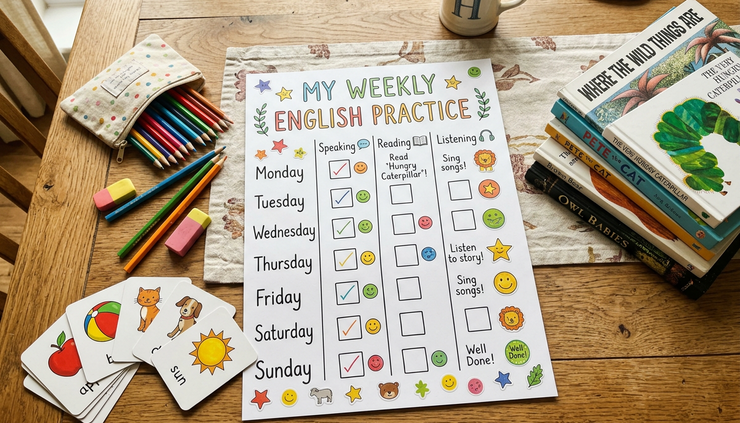
A simple weekly pattern might look like this:
Day | Easy speaking activity |
Monday | Talk about the day during dinner |
Tuesday | Read a picture book and retell the story |
Wednesday | Play a guessing game |
Thursday | Sing a song and act out words |
Friday | Watch a short learning video and discuss it |
Saturday | Play shop, café, or travel role-play |
Sunday | Review favourite words from the week |
The exact plan matters less than the habit. Confidence grows when English appears often and feels manageable.
Help your child speak more with a simple weekly goal
A clear goal gives practice a purpose. Keep it small and visible.
For example:
“This week, we will order snacks in English at home.”
“This week, we will use five new animal words.”
“This week, we will tell one short story.”
“This week, we will ask and answer three questions each day.”
Let your child help choose the goal. Children are more willing to practise when they feel some ownership.
At the end of the week, celebrate progress. You do not need rewards every time. A sticker chart, a high five, a phone call with a relative, or a special story can be enough.
The aim is not perfect English. The aim is a child who feels brave enough to try again.
If your child enjoys structured learning and playful challenge, you can also explore abacus and mental maths activities for children to build focus, confidence, and learning habits beyond language practice.
Frequently asked questions
How long should my child practise English each day?
Short daily practice is best. Aim for 5 to 15 minutes of relaxed speaking, reading, or play. If your child wants to continue, that is a bonus.
What should I do if my child refuses to speak English?
Start with listening and low-pressure activities. Read stories, sing songs, or play games where they can point, choose, or repeat one word. Avoid forcing full sentences before they feel ready.
Should I correct every mistake?
No. Correcting every mistake can make children nervous. Focus on understanding first. Model the correct sentence naturally, then keep the conversation going.
Can films and cartoons help my child speak English?
Yes, if they lead to conversation. After watching, ask simple questions about characters, favourite parts, and what happened. Watching alone is not enough for speaking confidence.
What if I am not confident in English myself?
You can still help. Use simple phrases, read together, listen to clear audio, and learn alongside your child. Your encouragement and consistency matter a great deal.
Build confidence one small conversation at a time
Helping a child speak English confidently does not require perfect lessons or expensive materials. It starts with warm, regular practice.
Talk during daily routines. Read stories and discuss them. Play games that invite speaking. Celebrate attempts, including the messy ones. Use apps or online courses as support, not as a replacement for real conversation.
Also Read Our Blogs on: Year 1 to Year 8 English Tuition Skills Every Child Should Develop How English Tuition Supports KS1 KS2 and KS3 Skills Confidence and Progress
With patience and steady practice, English becomes less like a school subject and more like a useful, familiar tool. That is when confidence starts to show: in longer answers, braver guesses, and the smile that comes when a child realises, “I can say this.”


Comments